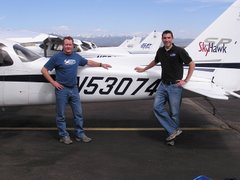
. . . you never know what they'll do!
Had a pretty decent flight with one of my students the other day . . . until the very end that is.
Practiced some steep turns and that's about all we had time for, since we spent the better part of our time talking during preflight about airport and radio procedures, airspaces, and such. Jim (not his real name . . . he'd kill me) had not flown in some time and we wanted to be on the same page as much as possible before winding up the rubber band in the airplane and defying gravity again.
See, one thing that's important to remember as a pilot is that gravity never ever quits or gets turned off. Very, very important to know.
[As an aside, one of the interesting things about instructing is that, at least at this point in my training as an instructor, I am learning just as much as the student is.
Only in a different way.
For example when I demonstrated a steep turn, I discovered that I really have not mastered them from the right seat yet. Sort of embarrassing that the instructor (me) had to take a couple tries to do a decent steep turn.]
Anyhow, back to my story. We were sort of (but not really) pressed for time since Jim had to return to his other life on the ground. So we headed back to the airport from the practice area.
Now Jim is a fairly advanced, competent, and careful student pilot with about 15 or so hours under his belt, and probably will solo soon.
But before he does, he's gonna need to get a better handle on landings.
Without going into extreme detail, landing is probably the most critical phase of flight. Not that the others are trivial because no phase of flight is trivial, but landing probably requires more focus, eye-hand coordination, and an understanding of the physics of what exactly is going on when the plane gets close to the ground and how you make it do what you want it to do.
Which, in this case, is make contact with terra firma as smoothly as possible. There's a good reason it's named terra FIRMA - it's pretty dang firm.
Part of this procedure involves pulling back on the control yoke to make the plane sort of level out, or flare as we call it, when the plane gets within about 20 or 15 feet or so of the ground. Depends on the type of plane, approach speed, and some other technical stuff like that.
During the flare the energy (speed) of the plane dissipates, the plane quits wanting to fly, and then it settles gently down to the ground on the main wheels, which are the wheels generally located under the wings or fuselage.
As opposed to the nosewheel, which, coincidentally, happens to be situated under the nose of the plane.
Ideally, the plane should be on the verge of entering a full stall just as the main wheels softly kiss the ground. Rarely happens that way, but you try.
Always trying for perfection.
Proper execution of the flare requires that the pilot sees where the plane is in relation to the runway as the plane descends toward the aiming point, and at just the right moment you pull back on the control to raise the nose of the plane.
We had done a couple touch-and-gos, and Jim did a great job on them. But on our last one, I think Jim was thinking about what he had to do at work or some such thing, but his mind was definitely not on the rapidly-approaching landing.
Because somehow he forgot to pull back.
When I realized that we were about to drill into the runway with our nose wheel - which is NOT a good thing - we were about 8-10 feet off the ground. So I not-so-gently took over, pulled back on the wheel and added a bit of power.
Now when I added that bit of power, it was just a bit too much of a bit and the plane did a little tiny balloon back into the air so I slowly pulled back on the power to bring us down.
We still landed just a bit harder than I like to, but not nearly as hard as we would have. Had I not pulled back on the wheel, we'd be filling out forms for the insurance companies and possibly the FAA too.
Or worse.
Anyways, all's well that ends well and as they say, any landing you walk away from is a good one. I don't necessarily buy that but . . . on this day I'll take it.
What I learned - very dramatically - was this: never assume that just because a student has done something right the first time, (s)he'll do it right again. And to go with that, until I'm convinced that the student's actions and focus are consistently the right ones, I will talk him or her through each and every procedure before we do them.
Amen to that.

19 March 2009
Those Crazy Student Pilots . . .


15 February 2009
One Step At a Time
OK, so I have had some difficulties the past few months, primarily financial. Which of course leads to challenges in most other areas as well, in this case putting a severe crimp on my flying. I did take the opportunity to begin doing lots of time in our FTD or flight training device, otherwise known as a simulator, so I haven't been a total slug.
I won't belabor the point about my troubles because I am fully aware that there are a great many people besides myself who are being financially hurt and stressed out by the current state of the economy, and the reality is that I am better off than many of them.
For which I am most sincerely grateful.
And as they usually do, things have taken a turn for the better and I am once again my positive and optimistic self. It also means I'll be ratcheting up my aviation activities, the most immediate goal of which is to take the Instrument Instructor and Instrument Ground Instructor written exams. Passing those, in addition to the exams I've already passed, will permit me to obtain certification as an Instrument Ground Instructor, which will allow me to sign off on student logbooks for simulator time.
That means I can then start earning some income doing what I really want to be doing - aviation.
Woo-hoo!
It won't be much to begin with, but as they say, every journey begins with a single step. And then another, and another.
One foot in front of the other.
One step at a time.
27 October 2008
Oops!
Oops is probably not a word you like to hear anywhere near an airplane.
Not quite as bad as "Uh Oh" and not nearly as alarming as "Oh Sh*t!"
Still, oops does tend to be an attention-getter. Fortunately, this oops occurred on the ground and not in the air.
Got clearance to cross a runway and contact ground. So the normal procedure is to cross the line, hold (meaning STOP), and call up the tower for taxi instructions.
So I motored across and as I did so, was explaining something to my left-seat student-passenger, can't remember what any more.
Now usually, I can talk and taxi an airplane at the same time. Perhaps a bit more difficult than walking and chewing gum but generally doable.
Somehow this time was different.
I crossed the runway and cruised right on past the hold line and automatically turned left onto the taxiway.
And faced right into an oncoming jet taxiing toward me.
OOPS!
One millisecond later, the controller on the radio not-so-gently reminded me that I was to hold and contact ground.
Mortified and stunned that I could have done such a thing, I sheepishly acknowledged and apologized. Stomped on the right brake and thankfully had enough room to do a 180 on the taxiway and get clear to the ramp.
Now would be a good time to point out that the oncoming jet was still quite a ways down the taxiway from where we were, at least 200 yards.
And I saw the jet stop moving so I knew that at least that driver was paying attention. And very likely muttering niceties in my direction while I flailed my arms and gnashed my teeth.
Anyways there was very little imminent danger of bending aluminum.
Still . . . it was a mistake. Probably my most serious mistake so far.
Mea culpa, mea culpa, mea maxima culpa.
A couple of lessons are now burned onto my synapses:
First, I allowed myself to get distracted during taxi. Distraction is a famous cause of accidents on the ground and I was guilty as hell. So in the future I resolve to pay a lot more attention during this phase of operating an airplane.
Second, I've always considered myself to be a very safe and attentive pilot but I now realize, sadly, that I am no different than any other pilot who gets distracted while taxiing.
In other words, I am not a perfect pilot.
Dang.
And that is perhaps the more important lesson.
Having an attitude of invincibility is one of the leading reasons pilots get into trouble, and I don't mean with the FAA.
Recognizing one's fallibility is a good step in the right direction of being a safe, confident, and competent pilot.
That's my story and I'm stickin' to it.