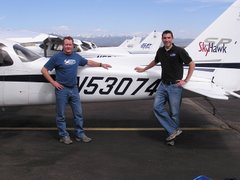
So this was my first 'big' aviation tradeshow and fly-in.
I'm told it's not nearly as expansive as Oshkosh (the biggest) but it's the largest I've been to yet, and it was all I imagined — flying machines of all types, sizes, configurations, colors, you name it - from home-builts and kits, flying bathtubs, hang gliders with lawn mower engines, and fully-functional scale models of actual planes, to biplanes, WWII warbirds and transports, active duty fighter jets including the Air Force Thunderbirds, aerobatic wizards, and even a wing-walker.
It was an amazing spectacle of the love, or possibly insanity, that compels people to defy gravity, and there I was in the midst of it all... feeling right at home, like THIS is where I belong, among kindred spirits.
I was like a kid in a candy store, like a pig in slop, like a... well, ok enough.
My friend Jeff and I along with a third pilot and videographer, Keith, were on assignment for PilotMag again, shooting video and stills while interviewing various pilots and conducting general networking and glad-handing for the adventure-flying magazine.
I was slated to travel commercially but at the last minute a spot opened up in TailWind's Mooney M20 (a four-place single engine) and I jumped at the chance to fly a real cross-country.
What did I know.
I was safety pilot for Tiago, my flying partner who was working on simulated IFR using foggles which only let you see the instruments (unless you cheat, which defeats the purpose). The plane performed flawlessly in mostly clear but hazy weather, cruising at 140 knots while burning only 10.5 gallons/hr. Tiago flew the plane really well too.
That was the good part.
The not so good part? Unfortunately the typical westerly winds were absent and we faced 30-40 knot headwinds practically the entire 1500 miles. Which meant that our 140 knots through the air translated into only about 110 over the ground.
So instead of about 10 or 11 hours enroute (with no wind), it took almost 15 flight hours with fuel stops in Wichita (ICT), Little Rock (LIT), and a much-needed stop in Montgomery AL (MGM) for both avgas and mental fuel in the form of a few hours of shut-eye before flying the final leg.
After departing Denver's Centennial (APA) at 7am Tuesday we finally arrived in Lakeland FL (LAL) the next day about 11am local.
It was a long flight and we were just a bit fatigued. And in need of showers.
Negotiating the crowded traffic pattern for arrival at LAL was interesting too, and that's all I'll say about that.
I'll talk about the show itself in the next installment but for now, know that it was a TON of fun meeting and interviewing industry people and pilots, shooting video and stills of all the action, and just down-right enjoying the atmosphere of like-minded folks who are as passionate about aviation as I am.
Our return flight was way more fun than the outbound. Again, non-typical easterly winds were slightly in our favor but this time we had some weather to contend with.
Most of the trip between Madison MS (MBO) to Wichita was in the soup, and Tiago and I logged several hours of actual IFR flying (instrument conditions).
As they say, it was Good Training.
One of the great things about ATC (Air Traffic Control) is that they will try to help you however they can especially when you are on an IFR flight plan so that's definitely the way to go when you think you might run into some weather. Or any time, really.
Our controller informed us of weather about 60 miles ahead. When asked what 'level' of weather was showing, he responded 'moderate to extreme precipitation.'
I'll admit to being a bit... concerned.
But Bruce, our instructor who was in the back seat, said 'let's keep going and see how it is in a bit.'
Ooook.
Now Bruce only has about 50,000 flight hours and so I thought, well maybe he's right.
Actually, I implicitly trust him and had zero second thoughts.
After about 40 miles we were handed off to the next control center, who told us he was seeing only 'moderate.'
After a slight course deviation to the left (west) to avoid the strongest stuff, we penetrated the clouds.
It was awesome - nothing but white outside the windows.
Time to see how my instrument scan holds up in actual conditions as opposed to the simulator.
Probably because I have had very little actual instrument flying time and my scan needs more work, but it's still amazing how quickly our plane wants to bank in the turbulent conditions inside the clouds.
Bouncing up and down? Pretty much what I expected.
Holding altitude and heading? Flying by hand, more difficult than I thought it would be. It's hard work and I have a new appreciation for autopilots.
Even after some time in the clouds, excursions of pitch and bank sort of happen unexpectedly and you have to react quickly to make the correct control inputs. But not too much - overcontrolling can be as bad as undercontrolling the airplane.
Anyway I can say that Tiago and I got a generous helping of solid IFR experience in the clouds and rain that day. We even went through about 60 more miles of clouds in eastern Colorado.
When we emerged near Limon, we were treated to an awesome sunset through a layer of broken clouds that were just beginning to be tinged with pink on their way to magenta and scarlet.
We turned northbound over Castle Rock for the approach to Centennial and when we had the airport in sight, it was a very satisfying feeling to know that yes, we are capable of planning and executing such a thing as flying across the country and back.
It's a beautiful thing.

23 April 2010
Sun-n-Fun 2010: Flight to Florida


29 March 2010
TailWind Aviation Sponsors Learn to Fly Day!
The flight school where I do some simulator instructing is one of the sponsors of a VERY exciting event coming up in May:
LEARN TO FLY DAY!
WHEN: 15 May 2010, from 10:00am to 3:00pm
WHERE: TailWind Aviation
8001 Interport Blvd, Suite 270, Englewood, CO 80112
(south side of Centennial Airport, see map below)
We will be doing lots of fun stuff such as giving tours of our facility, the flight line and airplanes, as well as showing a short presentation that will provide many details about learning to fly.
You might be wondering, how much does it cost and how long does it take? Well, you will find the answers to all your questions at this fun event - creative ways to pay for training and how you can save money, where you can fly, mistakes to avoid, and how to go from fun flying to being a career pilot, if that's your interest.
Tickets are required but they're FREE! Register for your FREE Ticket here:
Learn To Fly Day!
Or call Rebecca Hargis at 303-799-8439
I am REALLY looking forward to this so c'mon out and have a fun day!
07 December 2009
A Brand-Spankin' New Certificate
So after months of studying I was ready to go and take two FAA written tests in order to earn the Ground Instrument Instructor rating. The two exams I was prepared to take were 'Instrument Instructor' and 'Ground Instructor.'
One of the challenges that pilots face is to make the most efficient use of any and all money (and time) spent in advancing a career in aviation.
Each time you take an exam it costs you some money, $100 each. So you better be certain that you're taking the right exam at the right time.
On the morning of the day I was to fork over my $200 and take the tests, I was sitting in our office at TailWind Aviation, looking through the Federal Aviation Regulations — aka the FARs — one last time to make sure I really needed to take these exams.
You might wonder, well why didn't I do that before? The answer is that I did. But, you have to understand something about the FARs. And that is that, being written in bureaurocratese, the language in the FARs is somewhat... challenging... and often requires multiple readings to gain clear understanding.
Add to that the fact that there is an awful lot of knowledge overlap in the library of possible exams, presumably to cover the myriad pilot rating situations that arise.
After I don't know how many readings and discussions of the FARs over several weeks, my instructor and I decided on this day that by virtue of the two exams I already passed, 'FOI' (Fundamentals Of Instructing) and 'Instrument Rating Airplane,' I had the necessary qualifications to obtain the rating.
A quick call to the local FSDO (Flight Standards District Office) confirmed that I did indeed have the right stuff.
So now I am officially an FAA-certified Instrument Ground Instructor.
What does it mean?
Well, it means that I can work with students in our AST-300 simulator at TailWind, teaching tasks and habits related to instrument flight and flying in general. The sim is currently configured as a Beechcraft 1900, a twin-engine aircraft often used by regional or commuter carriers.
Being certified, I can sign student logbooks for simulator time, making it all official-like. And that means I can get paid for MY time.
And that's the whole point — a small step toward making a living in aviation.
Now all I have to do is rustle up some students...